



Are There More Great Whites In California Than Ever Before?
A firsthand shark attack story, a conversation with two researchers, and how to avoid becoming an accidental appetizer.
Welcome to Shark Week 2026. Here’s what’s live and what’s coming:
– The Trauma Gap: Surviving vs Seeing Shark Attacks
– How Reunion Island Escaped Shark Purgatory
– Op-ed: Why Australia Needs More Shark Nets
— Response: Why Australia Needs Less Shark Nets
– Tools To Survive A Shark Encounter
– Rasta’s Shark Theory
– The Great Shark Debate (July 26 PST)
Stoic and silent, older than dinosaurs, sharks have guided the progress of the ocean for millenia.
“Sharks have molded evolution for 450 million years,” says Paul Watson, founder of Sea Shepherd. “All fish species that are prey to the sharks have had their behavior, their speed, their camouflage, their defense mechanisms molded by the shark.”
Sharks have swam in silence as the continents have shifted. As old oceans have disappeared and new ones risen. As dinosaurs came and went.
They were slicing through the depths as Egypt piled stones into a triangle. Hunting seals on the day Jesus was crucified. Watching the moon when Rome fell.
They have survived five major mass extinctions, and they could smell blood in the water before we had a word for blood or water.
“When the sharks die, the oceans die,” says Watson.
The 1975 film Jaws transformed Hollywood. It became the first movie to surpass $100 million in box office rentals, set a new box office record with more than $470 million worldwide, and essentially established the modern summer blockbuster model.

On stabmag.com, shark incidents are guaranteed to go viral. Each year, our analytics prove that most surfers will click on a story about a shark encounter — especially if it happened near them.
Discovery Channel’s Shark Week is the longest-running and most-watched TV programming event of each summer. It consistently dominates streaming metrics, with the 2024 edition reaching 25 million total viewers across streaming platforms
Mankind is fascinated by sharks, and not simply because they’re dangerous. Hippos kill 3,000 people each year, but nobody is producing summer blockbusters about them.
Carl Jung suggested the sea is the favorite symbol of the collective unconscious. The shark then, is the perfect symbol for our own unseen primal darkness — ancient power, lurking in the depths. An actual monster under the bed, that could actually get us on any given afternoon.
They know what blood tastes like. They know what death feels like. They are older than the trees, quieter than the wind.
In Greek mythology, the shark represented a voracious, insatiable hunger. In Polynesian lore, they’re revered as protectors, guardians, powerful stewards of the sea.
To understand the mythos of the shark is to be confronted with a profound fear of the unknown, a magnetic fascination with hidden shadows. We are horrified by potential annihilation, and yet obsessed with the ancient darkness that might deliver it.
In the past 15 months, there have been 12 Great White shark attacks recorded along the California coast from San Diego to the Oregon border — one was a fatal attack on a swimmer in Monterey, six have been non-fatal attacks on surfers.
“I was paddling into a wave and was probably a second or two from popping up when I felt this weird pressure and dragging sensation on my legs,” James Eastman, an English teacher from Northern California tells me.
“It was strange and didn’t really hurt. It was just a dull dragging pressure on my legs. When I looked behind me, there was a shark out of the water with my legs in its mouth.”
James’ encounter was the most recent attack; happening in mid-March at a sheltered cove in the small town of Mendocino.
“I started fighting it as best I could, kinda pushing it and punching it on the nose and trying to get my legs free,” he remembers. “I’m glad I was still on top of my surfboard. I think if I wasn’t, it would’ve been a very different situation.
“It let go after a second or two of me fighting with it. It wasn’t a juvenile and I don’t think it was a monster. I think it was maybe 12 feet. It’s hard for me to know because all I could see was its mouth and head.
“Fortunately a wave came as soon as I got free, and pretty much everybody out there in the water with me also caught it to the shore. It was kind of a strange party wave.”
James was eventually helped to the hospital by a handful of local friends, where he received relatively minor surgery on his lower legs.
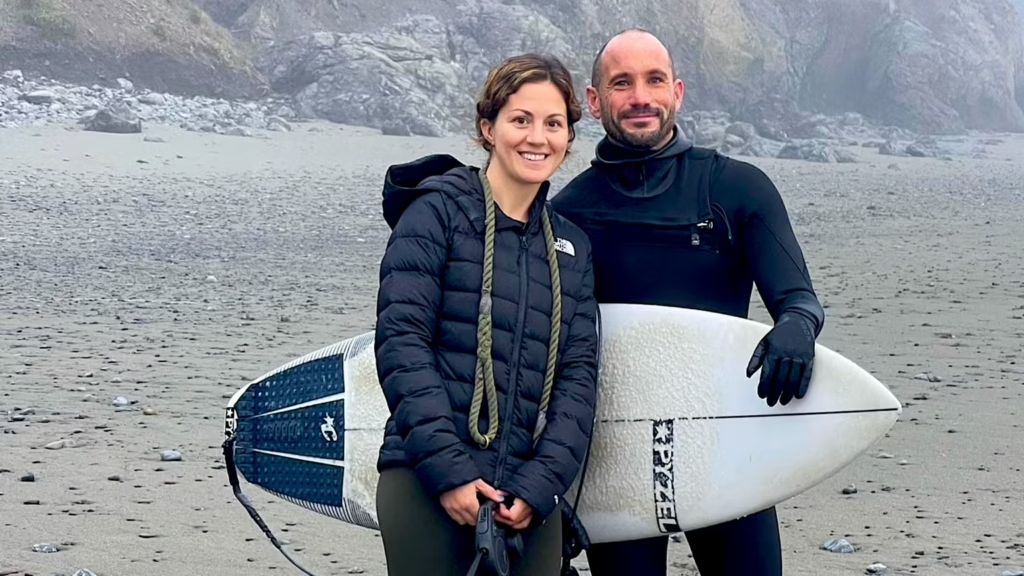
“Some of the laceration went to the bone and stuff, but fortunately none of them cut any arteries or any tendons or anything like that,” he says “Everyone is saying I’ll make a full recovery and be back in the water soon.”
We sent James a free year of Stab Premium for his troubles.
Twelve attacks in one calendar year marks a record for California. Certain notorious shark hotspots in Northern California have seen empty lineups on firing days through the end of winter. Though quiet, the fear is present.
Countless news sources have reported on the phenomena, but few have offered explanations as to why there have been an uptick in attacks.
Looking for an explanation, I called two men who have spent the greater part of the last two decades looking for sharks in the 27 mile expanse of saltwater between San Francisco and the Farallon Islands.
The Farallones are sharp protrusions of rugged granite bedrock that have risen from the Pacific’s depths. On a clear day, you can see their sharp silhouettes on the horizon from the Golden Gate bridge.
Decades ago, Sailors dubbed them “the Devil’s Teeth” due to dangerous, hidden underwater shoals and numerous shipwrecks.
Abused by wind, weather, and time, the Farallon chain is barren and tiny — with the largest island measuring less than a third of a mile around. Despite their size, they host the largest seabird breeding colony in the contiguous U.S. and are home to one of the highest concentrations of Great White sharks in the world.

Dr. Paul Kanive and Scot Anderson are the two main researchers on the California White Shark Project, a research initiative that is currently sustaining the world’s longest continuous survey of White Shark behavior and migration. The data collection began in 1987.
Paul has a PhD from Montana State University, where he wrote his dissertation on estimating the annual abundance of white sharks. He’s also an accomplished surfer.
Scot has a degree in Environmental Studies and began his work on the Farallones in 1987 as a volunteer. He was one of the first people to ever document shark predation events in the wild, and received an Emmy for his efforts after his footage was used in a 1993 BBC documentary on sharks.
From the moment I began speaking to both of them, it was immediately clear that they were not interested in sensationalizing or romanticizing their work. No bullshit, just a love for the game.
The entirety of their research is centered around the hundreds of White Sharks that migrate to the Farallon Islands each fall. For a portion of time in the late ‘90s, Scot lived on the Farallon Islands — a venture which is haphazardly depicted in Susan Casey’s 2005 book ‘Devils Teeth’.
“I have never seen an inhabited spot which seemed so utterly desolate, so entirely separated from the world, whose people appeared to me to have such a slender hold on mankind,” wrote Susan.

Now, the majority of Scot and Paul’s research is done via a 24-foot Radon boat, which they take out to the islands during the peak of the shark migration.
“The big migration that we discovered was that the sharks leave the California coast in the spring, and they go offshore to a place that’s called The White Shark Cafe. It’s about 1500 miles offshore between Baja and Hawaii. There’s no geological features on the bottom that would make it different from the rest of the ocean. It’s just a huge area. That’s where they go, but nobody’s been able to figure out exactly what it is that they’re doing. We speculate that it’s probably related to mating because there’s not a real good source of food there. Then the sharks come back to California in the fall and they’re skinny. They eat, they fatten up, they leave, then they come back skinny again year after year. This migration’s really important.”
The Farallon shark research season, Scot explains, begins at the end of summer.
”They start showing up to California in late August, and then it really gets going in September and October,” Scot tells me, through the receiver of his landline. “October is the middle of the season for our research because the weather is still good. Later in the season, the sharks are still here, but the weather deteriorates. In December and January, it’s hard for us to get out there.”
“We take the boat out there maybe once or twice a week during the season,” follows Paul.
The crux of their research is identifying individual sharks.
“The dorsal fin acts as a marker and each individual is different,” explains Scot. “So we can follow individuals over lots of years, decades even, as long as their fin doesn’t get damaged, and it usually doesn’t. It’s a reliable way to study individuals.”
Over the past three decades, they’ve encountered a handful of sharks repeatedly. So much so, that they have names for them.
“Paul and I have probably 25 sharks that we know really well that we’ve had a history of interacting with over the years. Cal Ripfin was named by a guy who was really into baseball. And then, Stumpy was one that had a cutoff tail. She was around 18 foot, a really impressive shark. She had this cutoff tail and she killed a lot of seals. Then there was Half-Fin, and then Two Spot. One was named Boots, a researcher named it after his uncle or something.”
After collecting the data on which individuals are present, they plug it into a handful of different statistical analyses.
“What Paul’s done is come up with a formula to take the number of fins that we see alongside a handful of other variables to come up with a population estimate of the Gulf of the Farallones,” says Scot.
That gulf stretches from Ano Nuevo in the south, to the Farallones in the west, up to Tomales Point in the north, comprising a large portion of the area commonly known as The Red Triangle.

“It doesn’t give you a complete population estimate, but it gives you an idea of the trends, whether they’re up or down or whether they’re here at all,” says Scot. “Otherwise, you really wouldn’t know they were around. They’re super cryptic and they go to these remote places where the seals and sea lions are. It’s hard to study them, but we’ve learned quite a lot.”
Paul explains that the last time they did the full statistical analysis — for the period between 2011 and 2018 — they saw a clear increase in population from the beginning of the period to the end.
“When we did that analysis, the total number of sharks in the area was around 350,” says Paul.
The distance between Ano Nuevo and Tomales Point is 85 miles as the crow flies, which suggests there’s roughly four Great Whites for every mile of coastline… and that was eight years ago.

When I ask them why they think there have been so many attacks this year, they both have a very similar appraisal.
“We haven’t done the statistical analysis yet, but we did observe more animals per hour of effort out there this year than we ever have before,” says Paul. “And just overall, we were able to identify more individual sharks than previous years. This year actually was the highest number of sharks seen at Tomales Point since 2020.”
Scot concurs.
“We saw more than we’ve seen in any other season,” he chuckles. “I think it was like 150 individuals. So, that’s a lot of sharks, considering they’re a highly mobile predator in a large ocean. Until we do the analysis we can’t say for certain that there’s been a notable increase in population. That said, with the populations of the seals increasing you would expect to see a shark population increase.”
Paul follows up with a few more of his own assessments.
“There’s several factors driving it,” says Paul. “White sharks have been protected since the mid ’90s. On top of that, their prey has been protected since the ’70s and has experienced an exponential growth in population. So when you have a prey base of any predator increasing to the densities that we see with elephant seals, sea lions, harbor seals, the response is that the predators are going to respond in positive numbers as well.
“On top of that, you have mitigation of the gillnet fishery, which was put in place to protect sea otters. Gillnets did impose some mortality on younger, small white sharks. Now that you remove that mortality, you allow those small sharks to grow up to bigger sharks.”
Operating with scientific integrity, they’re hesitant to make conclusive statements without the statistical analysis — but, all signs point to more Great White sharks on the California coast.

In October of this past year, the California coast experienced significantly warmer-than-average ocean temperatures due to a massive marine heatwave, known as The Blob. This event spanned thousands of miles, and may also have contributed to the increase in sharks.
“White sharks can swim around regardless of water temperature,” says Scot. “They’re warm blooded. But it could influence where sharks are because the prey they’re hunting may be attracted to the warm water.”
Throughout his time on the Farallones, Scot began conducting a handful of experiments on the sharks.
“Really, what I discovered about them is that they’re really wary,” says Scot. “Their attacks on things are very aggressive and they’re committed 100% once they decide to bite something. But at the same time, they’re really cautious.
“I did an experiment when I put a seal shaped decoy and then a square shaped decoy and I’d put them out for an hour at a time. They’d come up to the square and circle it, but they never bit it. Whereas the seal decoy would get bit half the time.”
More notably for surfers, Scot did countless experiments with surfboards floating on the surface.
“The first time I put a surfboard out, a shark came up and just blew it out of the water,” he says. “It became pretty obvious that they can tell the difference between a floating square and a seal, but they still get confused and think the surfboards are seals.
“Pretty much half the time they would attack the surfboard. Just blast it. Once they caught onto it though, they would just come up, circle it, and then go away. And some of them would never bite it again. They just knew.”

As written by Susan Casey in Devils Teeth:
“He was eyeing a perfect eight-foot barrel wave that rolled along an area known as “Shark Alley.” The wave, unsurprisingly, had never been ridden. Not for lack of surfboards, though. There was a quiver in the supply shed at all times – Scot used them as decoys to lure sharks to the surface for photo IDs.
“To a shark, apparently, a nice little six-foot swallowtail does a near-perfect imitation of a seal. When retrieved, the decoys were often missing hubcap-sized chunks from their sides, and surfers had taken to sending Scot their castoffs, hoping to repossess them after the sharks had paid a visit. Along with their research value, the strafed boards made for great conversation pieces.
“According to Scot and Peter, the Queen Annihilator of Surfboards was a shark named Stumpy. Stumpy was nineteen feet long and weighed five thousand pounds, and when she was in residence, she ruled the Farallones. “She was the only shark that I think understood who we were, what we were trying to do,” Peter recalled. “And she didn’t care for it. When Scot was first putting out the decoys Stumpy would just come up and destroy them, more because she didn’t like them than because she was fooled by their silhouettes.”

As a surfer who grew up in Northern California, I’ve always heard the old maxim ‘if they let you see ‘em they’re not gonna bite ya.’ When I ask Scot, he agrees.
“When they see something that they’re not convinced is going to be a seal or sea lion, they’ll come up and they’ll look at it and they’ll circle it. Usually they just go away after that. But the thing is, when they want to catch something, they can’t sit there and look at it and think about it. They basically go from directly underneath, straight up underneath and try to bite it as fast as they can. And that’s why people get bitten, because there’s a mistaken identity, whether it’s a swimmer or a surfer. Surfers seem to be pretty lucky in that they rarely get badly hurt. With swimmers, there’s a good chance you’re going to die because the whole bite is just going to be right in your midsection or whatever.”
Scot is adamant that just because there have been more attacks, there’s no evidence that White Sharks have developed a taste for human.
“They bite people and they spit them out, but they don’t eat them,” says Scot. “The woman that was recently attacked in Monterey, her body was found three days later. That’s usually the case. What white sharks evolved to do is eat blubber. Blubber is full of nutrients. It’s oily, has a particular smell and all the pinnipeds, seals and sea lions, whales and dolphins, they all have blubber.
“It’s super high density, rich, quality food. You couldn’t eat anything with better energy storage. The sharks eat that and then that gets stored in their liver as oil. They have a huge liver that helps give them buoyancy and they can go for months without eating anything.”
Another common theme I’ve heard in parking lot shark conversations is the idea that White sharks are more likely to attack during sunrise and sunset. Scot quickly dismisses this perspective.
“Doesn’t seem like there’s a specific time they feed,” he says. “Back in the ’90s, a guy analyzed all that data and basically they’re here or they’re not. And when they’re here, they’re just swimming around looking for food at all times of day.”
Shark attack prevention strategies range from painting eyes or zebra stripes on the bottom of your board to wearing bracelets with electromagnetic pulses on them. When I ask him, Paul doesn’t think any of these have much merit.
“A floating object at the surface painted any color is going to just be a silhouette against the contrasting light. Any color or patterns are shaded out. I don’t think that they would serve much purpose. And, as far as the Shark Banz, I’m sure you’re aware that the swimmer from Monterrey who died was wearing one. At the risk of getting myself in trouble from the shark wearable people, the research doesn’t really indicate that they’re effective.
“What I do worry about is how those wearable devices and any kind of belief in those devices of protecting somebody from not getting hit by a shark changes their behavior of putting themselves in situations where they otherwise wouldn’t.”

So, how can surfers in California prevent themselves from becoming an accidental aperitif?
“I think the main thing is that people should really pay attention to the seasonality of it,” says Scot. “Don’t go surf a sharky spot in September or October if you’re worried. In the spring, they’re pretty much not even here. And, if I’m talking to surfers who are gonna be surfing that time of year, I’d say just look at the places that have a history of attacks. Most of the spots are pretty well defined, like Dillon Beach. We know sharks hit surfers there. It’s happened before and it will probably happen again.”
And, the data backs up what Scots is saying. Click here to read a report on every shark attack in California since 1952. If you read through the data, you’ll see a lot of similar locations popping up frequently.
Paul offers additional insight.
“First, I think knowing whether or not there’s been a history of shark attacks at a wave, that’s a huge one,” says Paul. “And then, is there a lot of prey around? What time of year is it? How far away are you from help? Do you have cell phone coverage there? Are there other people in the water with you that could potentially help you get to safety or apply first aid? How good are the waves? Put all that into a decision tree and make your choice.”
Scot continues with a few other reactive measures.
“Carry a tourniquet, keep it in your bag, because there’s nothing worse than not being able to stop bleeding when you know somebody’s bleeding,” he says.

“It does help to have other people there,” follows Paul. “I have a trauma kit in my truck all the time, not just in case I need it, but in case other people need it. A tourniquet’s not that big of a deal to just carry around with you with some coagulant blood clotting stuff. That can stop bleeding and things like that. Prepare for the worst case scenario, then you can deal with it.”
“Also, your board is your shield, right?” continues Paul. “That’s why a lot of surfers don’t get fatal injuries like swimmers. A swimmer without a shield takes both the top and bottom jaw, where the surfers might just get one. When the sharks decide that trigger is pulled and they’ve made the decision that they’re going to go investigate and take a bite, it’s a lot of force. It’s a lot of power and it’s a lot of teeth. And if your surfboard can take the brunt of it, you’re going to be better off. Anything that’s hanging off the board or exposed that way is more in danger of getting harsher injuries,” he finishes.
Feet up, then.
A separate research initiative, the Monterey White Shark project, has a live shark tracker for tagged White sharks at Año Nuevo island. You can click here to view the data. According to the latest update, there have only been three sharks that pinged on the receiver in April, May, and June — compared to hundreds during peak season.
This suggests that the sharks have mostly departed Northern California, headed for the shimmering blue waters between here and Hawaii.
As for Southern California? According to this article, warmer waters near Baja seem to be allowing female sharks to give birth earlier, meaning it may be a sharky summer south of Santa Barbara. Typically however, the majority of sharks in the Southern California bight are juveniles around 10-foot and under, far less likely to turn your stringer into splinters.
So, enjoy your south swell pulses, while Stumpy and her girl gang of 19-footers are enjoying a few flat whites at The Cafe.