




Why Does China Send People To The Moon?
We asked the designers of the world’s best air section.
Wave pool technologies are relatively easy for the unscientific mind to comprehend.
First, you get a body of water. Then, move some paddles around, blast it with air, or drive a fucking train through it. And, just like that, waves.
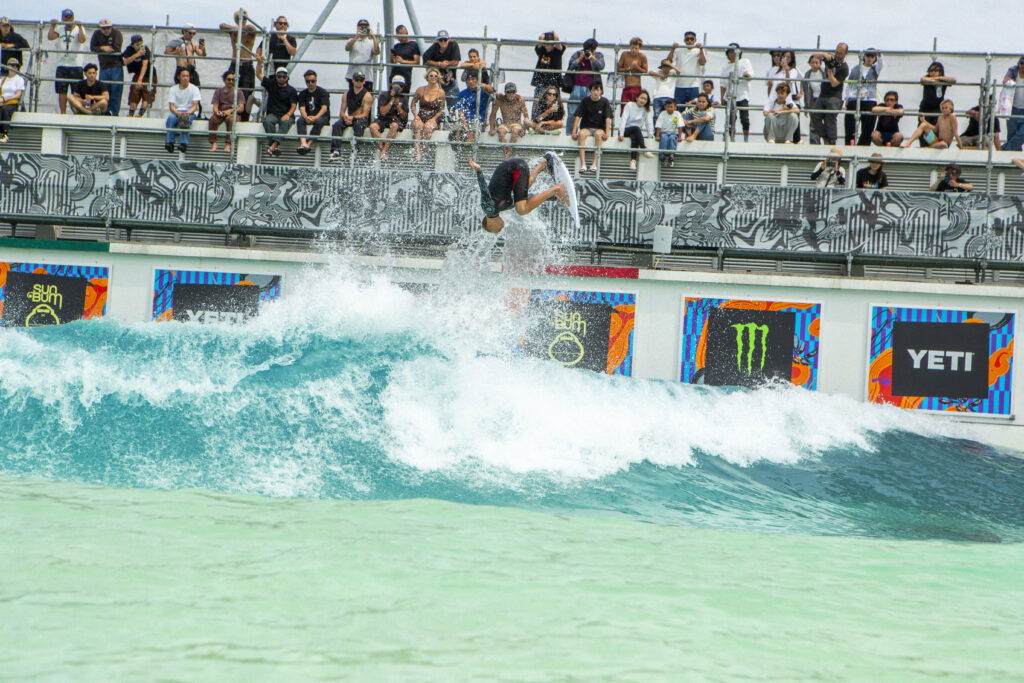
We have been referring to the air section at Riyue Bay as the world’s best. Why? It seems to produce the highest airs we’ve seen in a wave pool. And even the average air there just seems to be higher than what we’re accustomed to.
But can we find something resembling science to back that claim up? To answer that question, I called Willy McFarland from American Wave Machines, the creators of PerfectSwell, and that section.
To start: How do you create an air section?
“You create an air section by drawing water away from where you want the section to be,” he says. “In doing that, you’re creating movement and a depth change in a precise location. That’s what initiates the crumble for the section.”
“In general, we’re sequencing water in very calculated ways,” he continues. “You do that in front of the wave, and you get a result on the wave once it gets there because it’s traveling over a different patch of water. In he same way, you can manipulate the takeoff and control how steep or soft you want the waves to be, among other things.”
Ok. So, less water = wave breaks = air section. Makes sense.
Next, I asked Willy about the speed and size of the wave. Because, surely, bigger wave + faster wall = bigger air.
“Air section waves tend to work best when they travel faster than our high-performance turn waves,” Willy says. “In general, they’re moving about 20% faster. But they are actually a little bit smaller because, by moving them faster, you’re stretching the wave out. A spring is a decent analogy. It’s tallest when it’s fully compressed. Once you stretch it, it becomes thinner.”
Got it. So, we’re on to something here. However, Willy delivered a caveat. “The speed matters for sure, but that’s really not what sets this section apart.”
“The air section you’ve seen a lot of at Riyue Bay is called the McFly,” he continues. “We debuted that section in São Paulo, where you may have seen Pedro Barros do that huge backside air. Essentially, what sets it apart is the verticality of the section. The launch point is higher relative to the rest of the wave. As a result, it really wants to push surfers upwards.”
Willy referred to the verticality as a “lift” dial that they can control. So, why not turn it all the way up?
“There’s a trade-off between potential height and projection back towards the beach. If you max it out, you might get a little more verticality and a higher launch point, but you’ll see people landing out the back way more.”
Got it. Fast wave + vertical section = very big air.
So, finally, from Willy’s perspective: Does Riyue Bay nail that equation better than anywhere else?
“Every pool has its own intricacies and subtle differences,” he says. “São Paulo and China have our new, more powerful system. Riyue Bay, in particular, has a very powerful setup. I think it’s fair to say we’re getting a little more punch out of it. So yeah, it’s definitely the biggest section we’ve made.”

While Willy admits he’s not an air guy, both he and the rest of the wave design team, lead by Miquel Lazaro, have designed enough sections with the world’s best air surfers to offer some insight regarding how to succeed on the Stab High China section.
“Timing is crucial. If you’re precise, you get a much steeper section and you go higher. If you’re early, you might do a flatter, more projected air. I think that’s why guys like Pedro and Ryji have done so well on it. With their skate backgrounds, they’re used to going straight up at a section and projecting upward.”
Godspeed, and Godlift.


Comments
Comments are a Stab Premium feature. Gotta join to talk shop.
Already a member? Sign In
Want to join? Sign Up