











Spotted: The Infamous Macaronis Saltwater Crocodile
Jack Robinson, Leo Fioravanti and Kanoa Igarashi get front-row seats.
This time last year, Jed Smith penned a piece for us asking: Does Indonesia Have a Croc Problem?
Well, that depends on how you define “problem.”
Are surfers being chomped by these ancient amphibious reptiles with any great frequency? No. There have been reported attacks on surfers in Darwin and Costa Rica, though both victims survived.
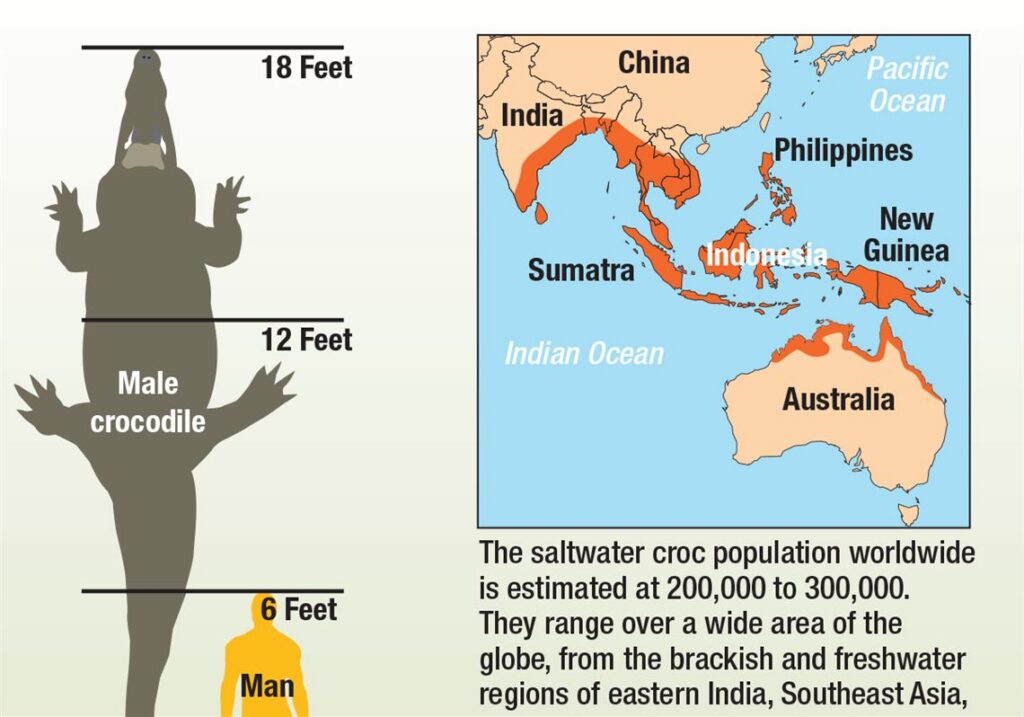
Saltwater crocodiles inhabit tidal river mouths and estuaries throughout the Indo-Pacific. But Indonesia takes the cake for the highest rate of crocodile attacks in the world. In the decade leading up to 2023, more than 1,000 attacks were recorded, resulting in 486 fatalities.
The true figure is believed to be higher, thanks to limited media coverage and official record-keeping in rural areas, along with the obvious tourism incentives for keeping quiet.
Legendary Indies skipper Martin Daly put it bluntly: “We know why no one’s talking about it. It’s bad for business.”
When Daly first arrived in the Mentawais, local villagers would paddle out to his boat in dugout canoes and attempt to sell him baby crocodiles. He believes there are now more full-sized versions roaming the islands than ever.
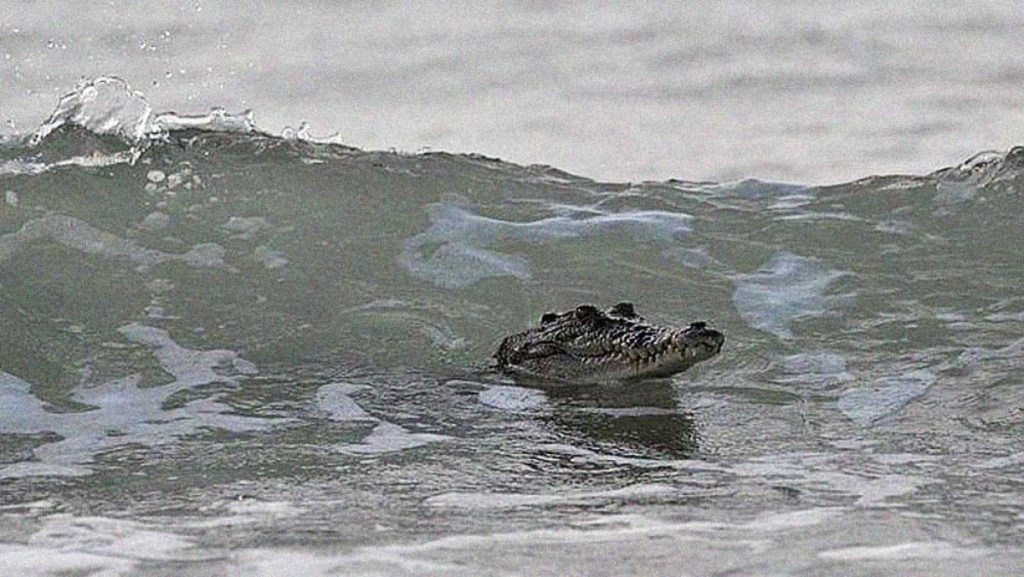
“There seems to be more around now than there’s ever been,” said Daly. “In the Telos, they’ve got video of one swimming through town. They lost a kid up there the other day. Macaronis has always had rumours. Those rumours aren’t rumours now that a guy videoed one swimming past all the boats in the anchorage.”
Which brings us to today.
Leonardo Fioravanti, Kanoa Igarashi and Jack Robinson are currently posted up in the Mentawais for a bit of a throwback to the Young Guns days. After Japan, they’ve moved on to the 17,000-island archipelago for a pre-Tahiti tune-up.
While parked in the channel at Macaronis today, the crew got a clear view of the four-metre reptile known to frequent the nearby estuary.
Here’s the World #1 almost pulling a hamstring sprinting to film it…
Among the skull emojis were some pretty funny comments:
“Yo, I’m about to paddle out. Can you get the housing ready?”
— Kanoa Igarashi
“They only eat Brazzos.”
— Cory Pierce
“Go give it a lil pat.”
— Raglan Surf Report
There were also a few slightly more informative contributions.
“Spent a week anchored right there, swimming around the boat. Same in the Telos, when we were anchored up in the mangroves for close to a couple of months, swimming night and day. Then one night, under a full moon, we spotted the eyes of a croc circling the boat. The following day, we were sailing to the closest wave, about one nautical mile away, and saw the same croc swimming in 30 metres of perfectly clear water. I believe it recently attacked and killed a local lady in the same area and was then put down.”
— Torren Martyn
“It’s there all the time in the estuary near Macca’s Resort.”
— Kelly Slater
According to one anonymous source, many of the rules and warnings at nearby land camps exist because of the armoured lizards prowling the surrounding mangroves.
“Just point a torch at the water and you’ll see how many eyeballs are looking back at you.”
“It’s a genuine risk, and I think it’s absolute bullshit that people don’t talk about it, as if acknowledging it is somehow a bad thing,” Daly says.
Further west, on the island of Sumba, local retreat owner Christian Sea has become a reluctant expert on saltwater crocodile habitats and behaviour as sightings and encounters have increased. He believes the recent rise in fatalities and injuries is connected to crocodiles migrating from Australia’s far north to Indonesia, a distance of roughly 150 kilometres at the countries’ closest point.
“The crocs are coming over from Australia,” says Christian. “They ride the trade winds, and they look like the normal crocs that are here, but they don’t act like the crocs that are here. They are way more aggressive and have much more of a tendency to attack humans.”
Until five years ago, he had never seen a crocodile on Sumba. Then, after a 10-day run of strong trade winds blowing from Australia towards Indonesia, locals spotted one swimming across the bay in front of his retreat.
Saltwater crocodiles are all classified as the same species, Crocodylus porosus, but they are not necessarily identical everywhere they are found. Variations in size, colour and behaviour have led some experts to call for further classification.
According to Christian, the Sumba crocodile spent the next five months moving between beaches along the island’s west coast, including several surf spots, among them Nihiwatu, otherwise known as Occy’s Left.
Maybe just kicking up a stink after being omitted from Shark Week?


Comments
Comments are a Stab Premium feature. Gotta join to talk shop.
Already a member? Sign In
Want to join? Sign Up