





Hossegor Beach Cocaine Episode 1: Y2K To Infinity
A new Stab Premium podcast series.
Ed note: Inspired by the work of his personal hero, Joe Rogan, Paul Evans has decided to put down the quill, pick up a microphone, and do his own research for this latest truth-telling manifesto. Hossegor Beach Cocaine is Paul’s (and Stab‘s) first attempt at a narrative-style podcast, delivered in four episodes over the next four weeks. We’ll be uploading the first episode on all podcast platforms for free, but episodes 2-4 will live exclusively on the Stab Premium app and now Spotify (thanks to our tech-savvy Premium Director, Jimmy).
Hossegor Beach Cocaine release schedule:
Episode 1: Y2k to Infinity (free, below!)
Episode 2: The White Tide (Stab app: Friday, August 14)
Episode 3: Peaking (Stab app: Friday, August 21)
Episode 4: What Goes Up (Stab app: Friday, August 28)
On a cold, rainy day in late December 2003 I was driving through Soorts with a friend.
We saw a guy hitchhiking by the church, he said he wanted to get to Hossegor, we said hop in. There wasn’t much public transport at the time, you’d generally pull over if you saw someone hitching. Karma and all that.
There may have been a spliff burning in the car at the time. Even if there wasn’t, the guy had decided we probably weren’t the cops. Once in the car, he asked if we’d heard what was happening on the beach, drugs washing up every day for the past few weeks, lots and lots of drugs. He’d come all the way from Toulouse, several hundred km away, and seemed pretty keen to get to the beach that day, despite the weather.
By the time it made the TV news a week or so later, the authorities said they’d recovered over a thousand kilos, likely a tiny fraction of what was out there, being picked up every day. Over the next few months, lots more packets washed up along the coast, — every time there were strong onshore winds, more gear appeared at the high water mark. The police were out patrolling the surf spots, watching what you were carrying after a surf. Lots of people were suddenly out walking dogs on the beach early in the morning. If they didn’t have a dog, they borrowed someone else’s.

As well as drugs, some people were reporting finding bundles of cash: US dollars wrapped up in basketballs. At a small seaside town in mid winter, whispers of vast amounts of illegal drugs worth huge sums of money on the beach was a departure from the usual chitter chatter about who’d dropped in on who, who’d hooked up with who, or indeed, who’d dropped in on then hooked up with who.
Some people went out looking for it, as our hitchhiker seemed to be doing, while other people just seemed to chance upon it. Come out of the surf, reach down to take your leash off, and notice an unusual looking brick wrapped in plastic right by your foot. Or several. So now then, what to do: call the cops and avoid potentially getting into serious trouble with the law? Check nobody’s looking, pick it up and start walking?
The people who decided to share their stories in this podcast series — all surfers based in the area at the time — chose the latter.

A couple of years ago, a production company in London hit me up about making a documentary about the beach cocaine from the early 2000s. I thought a talking heads type documentary (How Surfers Got Drugs) would be tricky, most crew directly involved probably wouldn’t really want to go on camera, for obvious reasons. So then you’d mostly just end up with hearsay, interviews based on rumours, “I heard this happened…” That didn’t feel like particularly compelling viewing.
In order to get real accounts from the actual characters involved, from finding stuff on the beach to how it changed lives over the months and years that followed, an audio podcast seemed like a decent solution. People like listening to podcasts, true crime is a popular genre; plus people are much more likely to talk honestly and openly to a voice recorder, rather than having a camera shoved in their face. Then other work and life commitments came up, and I put the idea to one side for a while.
When I eventually circled back on it, I thought I’d pitch it to Sam and Birdy from Stab. I wasn’t expecting to hear much back, but they both replied within a couple of hours.
“Do it.”
Southwest France in the late 90s and early 2000s was on the rise in all sorts of ways. People had long known about it as a summer surf trip, but basing yourself year-round was becoming more and more of a thing for surfers from all over the world. Australia had long seemed the place to go if you were to up sticks and move to another country to live and surf. But wait, why are all these Aussies moving to France now? Pro surfers coming off tour and basing themselves here, what’s that about? Were the waves really that good? What about winter though?
Legendary surfers that had been attracted to settle in southwest France in the ’90s included Miki Dora, Jeff Hakman, Tom Curren, Maurice Cole, Martin Potter, Gary Elkerton, and Robbie Page. Welsh pro Carwyn Williams had set up a surf house that acted as a conduit between some of these icons and everyday punters. To an outsider, it felt like these lords were living out their days getting barrelled at secret sandbars, drinking fine wines, playing golf, being feted by local dignitaries, and receiving a decent stipend from core surf brands for their troubles. When winter came, they slipped into their sponsor’s outerwear and went snowboarding in the Pyrenees. And then when summer came around again, it was back to the joyful dance of nude beachies, empty sandbars and long, golden evenings eating duck.
By the early 2000s, action sports were part of a new way of approaching the work/life balance for the 21st century, new leisure scenes sprung up globally around natural resources like mountains and waves. Working all week and paying to go watch a team sport was still the mainstream, but board sports were growing in confidence as an alternative lifestyle for the new millennium. Europe’s surf scenes had developed much later than the US or Australia, its waves much less crowded. While the major brands were all from the Anglophone surf epicentres, southwest France added its own identity, particularly with Quiksilver, which actually felt quite French. Surfing could be part rebellion, part appreciation of the finer things in life; also quite French.
As an outsider moving here, there seemed to be a lot fewer rules than in other places, or maybe just less enforcement. It was normal to see cops smoking in uniform, or taking a pee by the side of the road. They also didn’t seem to have radio in police cars, if they pulled you over, you’d hand them a piece of paper to show whose car it was, as opposed to at home, where they already knew the address of the person the car was registered to, and if they had any outstanding parking tickets/murder charges, before pulling you over. Actually, the beach car parks were free anyway, which felt ideologically significant as much as financially. This was just before they clamped down on sleeping in cars and vans at the beach.
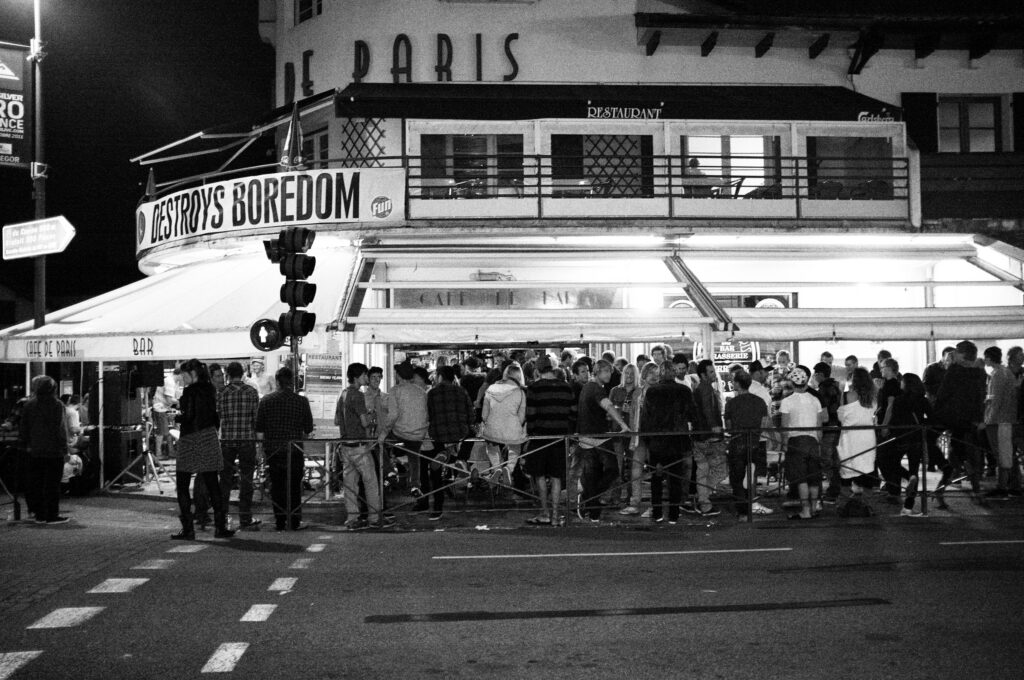
Aside from relatively few surfers compared to other places, the overall lifestyle was very laid back. Hossegor is kind of in the middle of nowhere, one road in, one road out. You could get away with lots of things that elsewhere, a combination of political correctness and health and safety rules had legislated out of existence. In California, it was illegal to smoke a cigarette on the beach, in France it seemed like it was illegal not to. If you weren’t bothering anybody, nobody really cared what you were doing. Drinking in a public place was not an issue, you could even drink a beer whilst driving your car so long as you weren’t over the limit. If you were over the limit, well taxis didn’t exist here, so drunk driving was the norm rather than the exception, there definitely wasn’t much social stigma attached to it. The party scene was really surfie, pretty cheesy, but still lots of fun in spite of itself. Nights out generally finished late — dawn patrol was a fairly niche pursuit.
After the inception of the ASP Dream Tour, moving the France CT to autumn and prime swell season instead of mid summer, Hossegor developed what seemed like a mini North Shore season in September/October. Surf brands set up team houses, bringing their freesurfers to town to surf and shoot. The social epicentre was the Volcom House at Culs Nus, the next spot up from la Gravière, where travelling surfers from overseas mingled with resident pros and ams alike. Before it became the Volcom house, it was known colloquially as The Stables by its owner, Dave Mailman, who worked in marketing for Quiksilver.
In Ep. 1, Y2K To Infinity, we hear from Dave on how brand power developed surfing in the town at the time, as well as Nicolas Dazet, who also worked at Quik and was a pivotal figure in shooting local pros on the come up at the time. We also hear from Laurent Pujol who describes the appeal of the area’s waves and scene to outsiders, and explains how he modelled his career as a pro on Maurice Cole’s unique approach to scoring Hossegor’s notoriously fickle waves.