



The Psychology of Climate Change
“There’s no harm in becoming more environmentally friendly” – Professor Ben Newell chats to Stab about the role of surfers in the ongoing climate change discussion.
If you “agree” with 97% of climate scientists, at the very least you may have feigned interest in the future of our home planet; perhaps even enough to vote, turf disposable plastic bags, or switch out the old petrol guzzler for two wheels and a chain.
You all know the usual line of attack: “reduce consumption of non-renewables”, “sell your car”, or maybe ditch the meat to adopt the vegan lifestyle of Kelly Slater.
But, what if climate change isn’t happening. Would it be all that bad to ditch the pollutants in exchange for more renewable products, which might also be more durable?
These arguments also apply to surfers.
Not in the sense that we should all be ‘earth-conscious’ (because we’re all doobie toking hippies), but because the materials we use are primarily developed from fossil fuel dependent processes. Young ‘millennials’ like myself have arguably been indoctrinated; happily hopping aboard the enviro bandwagon, occasionally without considering the evidence ourselves.
The evidence clearly leans heavily to the pro-action side, but I doubt any of you want to hear pseudo-intellectual spiels about what we should be doing to combat climate change – not from me, at least.
So I asked someone who genuinely knows what they’re talking about…
Professor Ben Newell, from the University of New South Wales, who works to not only understand the science behind climate change, but the psychological factors which influence a person’s beliefs about climate change.
Ben has studied cognitive psychology for over 20 years, but has only focussed a subsection of his research towards the “psychology of climate change” over the last six or seven.
“I became interested when I started to realise the connection between my research on judgement and decision making and their relation to people’s beliefs in climate change.”
Disclaimer: Conservatives and sceptics may be offended by the following interview – don’t say I didn’t warn you – but consider a sort of environmental Pascal’s Wager, as you fume, would ya?
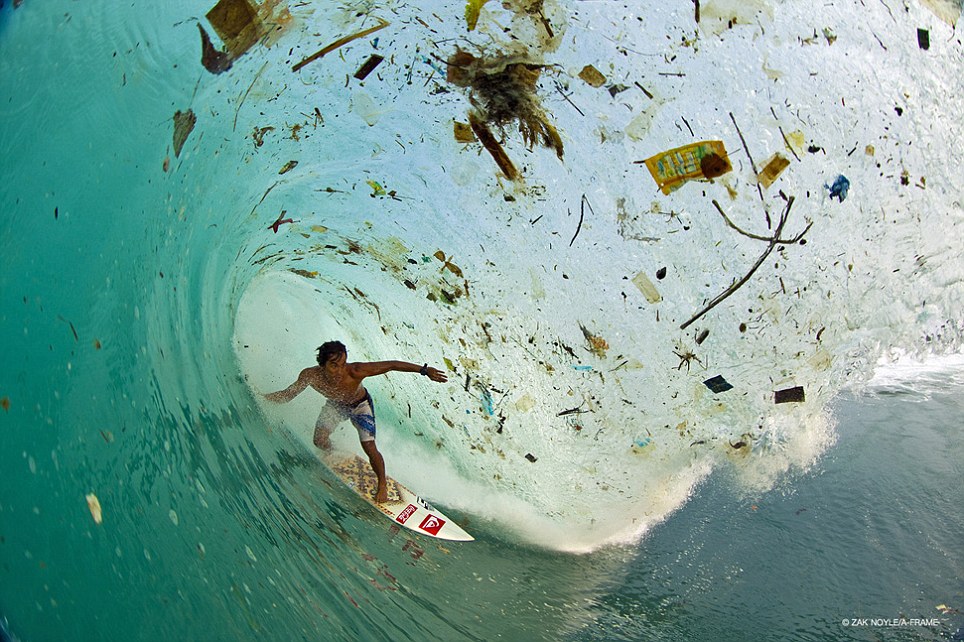
Do you like this view? Waste is an adjacent issue to climate change in many respects, yet one which still contributes to the negative environmental impact of humans.
Photography
Zak Noyle
So Ben, what are the relationships between cognitive science and climate change?
Professor Ben Newell: There are so many uncertainties in climate science, and our understanding of it. By considering models and theories of human choice, we may be able to understand the factors which influence whether a person believes or doesn’t believe in climate change.
If the science is clear, why isn’t everyone on board to reduce environmental impact?
One way of looking at it is the notion of psychological distance, which has four dimensions: hypothetical, social, spatial and temporal.
This is the distance you can put between yourself and and something else — therefore, if you think of climate change as an entity, you can imagine how ‘far away’ it is.
It allows us to distance the problem; a problem which may or may not directly be affecting ourselves. If we’re able to distance ourselves from the impacts, then it’s much easier to not care about it and remain content with our current behaviours.
Out of sight, out of mind.
So for instance, a person might care more about immediate things—profits and convenience—than, say long term investments towards a better future?
Yeah, because these (coal and fossil fuel products) are currently the easiest and cheapest energy sources to obtain. Particularly in Australia.
Furthermore, people place a greater importance on events occurring ‘now’ and reduce the worth of events in the future; a theory known as temporal discounting.
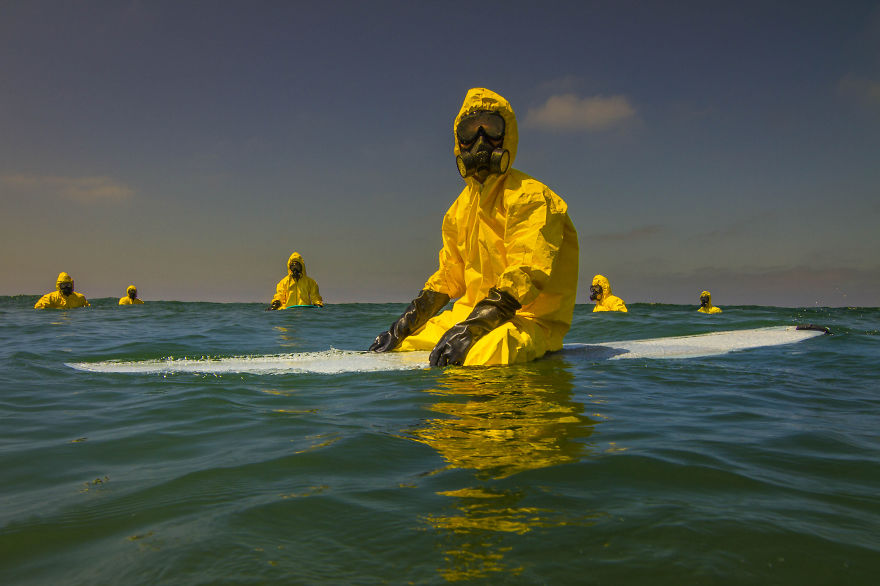
Say the Earth and oceans does turn to shit, at least we’ll always have hazmat suits to solve our issues.
Photography
Mike Marshall
What are some impacts directly relevant to the oceanic ecosystem?
Sea levels are an immediate threat, which we’re already experiencing, however, this is a hard one to directly perceive.
As surfers, there’s no perceptible difference in sea levels from one surf to the next — other than the tides. But, if the predictions are accurate for rising sea levels, then we will see large longer term consequences as surfers.
The waves we currently surf will no longer be there or your favourite high-tide spot will only be working on low. Not to mention the devastating impacts to multiple island nations.
We also don’t have a complete understanding of the way in which increased water temperatures will influence current circulations and their impacts on the relevant feedback systems. We know that this will result in changes in weather systems—likely leading to more storms and unpredictable weather patterns—but at this stage the severity of these impacts is still being researched.
From a selfish perspective, could this mean larger and more frequent swells for us surfers?
Definitely. In some regions, it will likely result in bigger swells to chase, which will be more frequent, however, this doesn’t outweigh the negative consequences of these types of storms.
Should surfers care more about the environment than the average person, since we rely on the ocean and environment for our kicks?
Yeah I suppose so, in regards to how often we’re in contact with the ocean, our daily lives may be affected more so than the average person. We (surfers) and anyone who cares, can do something to try and stop it, whether it’s raising awareness or changing our own environmental behaviours.

The mean sea levels rise from 1993 to 2012. A rate of increase which has remained scarily constant.
Photography
Skeptical Science
Perhaps surfers should be at the forefront of environmental issues?
I used to be a part of the ‘surfers against sewage’ association in the UK – who are still going today. We were specifically campaigning to stop the release of untreated sewage into the ocean and we had a lot of success via this organisation. We were directly experiencing the impacts of sewage release as it would come around the headland to where we were surfing.
But in relation to climate change, it’s difficult to raise similar awareness, since we can’t always observe the salient impacts of climate change in the same way you see sewage floating through a lineup. You can measure average sea level and temperature changes, but they’re difficult to detect without appropriate equipment.
As an individual surfer what can I do to reduce my immediate impact on the environment?
You could ride your bike to the beach instead of driving your car.
(Authors Note: Ben knows I’m too lazy to ride a bike)
So driving here today was a bit hypocritical?
Ha!..just get a board rack.
Additionally, I guess we can buy more environmentally sustainable products that we use when surfing. The materials and processes which go into making standard boards and wetsuits are incredibly harmful and toxic (e.g., CO2, CFC’s). Furthermore, you can’t do anything when you bust a board since they’re non-recyclable, they just go straight to landfill. Old wetsuits can be cut up and maybe used as a springsuit, but they’re certainly not genuinely recyclable products.
Should we be moving towards companies who create more sustainable products.
Yes, we should move towards more sustainable products, but until the prices come down it is unlikely anyone will buy them on a large scale. The price though will only reduce with an increased demand, but to increase demand we need spokespeople who publicly support these products to drive consumer behaviour.
People like Kelly Slater?
Yep, but we still need more of that. People championing environmentally boards and suits.
This creates a more competitive market for these products and in turn reduces the prices for surfers buying them. Until that happens, they will unfortunately remain more costly and out of reach for the average surfer. .
Are there other approaches that should be taken in trying to persuade people to buy more ‘environmentally friendly’ or recyclable products?
If some of these products – such as Epoxy boards and non-neoprene wetsuits – are shown to be more durable, then this is likely a better approach to adopt.
People are always biased towards the present and value it more than future events, but, if you can make a clear argument as to why these products are worth a larger initial investment, then that’s a positive. But you’re talking to the wrong guy, I’ve worn the same wetsuit for 10 years.
Ha! That’s a good thing, you’re recycling!
(laughs…) less ‘recycling’ and more ‘reusing’ though.
Other than bust my bank on boards and wetties what else can I do?
Another approach is to try and raise awareness amongst your peers and friend circles. Whether you want to become politically motivated or write articles about it. Those are the sort of things which can be done quite easily.
It is tricky though because you don’t want to overwhelm people and then demotivate them to act. Especially with surfing, which people do because it’s a source of enjoyment. You don’t want to start associating this with guilt every time they go surfing.
In many ways surfing is already a very low impact sport, we’re not racing cars around a track. So overall you could argue that our carbon footprint is already comparably low.
What if I want to convince my peers we should act on climate change?
Tell them to look at the data…(laughs)!
Even if it’s not happening, show them that it’s not going to be a bad thing for us to reduce pollution or use recyclable materials. What’s the worst that could happen if we try to burn less coal and create less pollution?
Compare this to the negative consequences if we continue the same behaviours and climate change turns out to be anthropogenic and catastrophic. When you look at it this way, regardless of the climate change, renewable investment is the obvious choice.
Thanks for chatting with us, Ben. Any final remarks?
I think it’s important to hammer home the message as much as possible. Particularly in showing that there’s no harm in becoming environmentally friendly. Even if it somehow turns out that Trump was right and climate change is a sort of conspiracy theory invented by NASA and the United Nations…
*****
So, how many of you down below will never be driving a car, buying a wetsuit or riding fibreglass again?


Comments
Comments are a Stab Premium feature. Gotta join to talk shop.
Already a member? Sign In
Want to join? Sign Up